
Sports Vision Training in Buckhead: Skills Beyond Clear Sight

Sports Vision Training in Buckhead: Skills Beyond Clear Sight

Sports Vision Training in Buckhead: Skills Beyond Clear Sight

Sports Vision Training in Buckhead: Skills Beyond Clear Sight

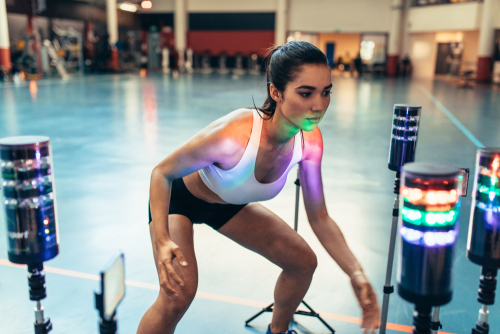
Sports Vision Training in Buckhead: Skills Beyond Clear Sight
An outfielder can read the scoreboard from center field and still take a step forward on a fly ball that sails overhead. The letters on the scoreboard stay put. The ball changes position against the sky with every step the player takes. At our Buckhead practice, we offer sports vision training for athletes who want to work on the visual skills behind plays like these.
What 20/20 Vision Tells Us
When you read an eye chart, we measure how clearly you can see detail at a set distance. A basketball court asks a different question. Can you pick up a pass, find the rim, and notice a defender closing in while your feet are moving? Each part of that play draws on a different visual skill, even when the ball and basket both look sharp.
That distinction matters when an athlete says, “I can see the ball, but I keep missing it.” We want to know what happens between seeing it and trying to make contact. Following its path, anticipating where it will arrive, and timing a swing are separate parts of the same play.
Visual Skills Athletes Use During Play
Eye tracking helps you follow a moving target. In tennis, you use it to follow a serve from the opponent’s racket, across the net, and down to the bounce.
Depth perception helps you judge distance. A volleyball player uses it to decide how close a set will come to the net and where to plant before jumping.
Peripheral awareness helps you notice movement off to the side. A soccer player watching the ball may catch sight of a teammate starting a run along the sideline.
Focus changes let you see clearly as your attention shifts between distances. A catcher uses this skill when glancing from a ball in the glove to a runner at second base.
Hand-eye coordination connects what you see with how you move. A goalie reaching for a shot has to get the glove to the spot where the puck is headed.
What We Look for During an Evaluation
At our Buckhead office, we start by asking about your sport, your position, and a play that gives you trouble. If you lose track of fly balls, for example, can you see the ball leave the bat? Does it disappear against a bright sky, or can you follow it the whole way and still misjudge where it will land?
For younger athletes, a coach’s observations can help. Knowing a child catches short throws consistently but struggles with longer ones gives us a useful comparison.
Those details help us decide what to assess. Depending on the concern, we may check how smoothly your eyes follow a target, how accurately you judge distances, or how easily you shift focus. We use the results to identify a skill worth practicing and explain how it relates to the play you described.
How Training Fits Your Sport
If changing focus is difficult, an exercise might involve reading a letter on a card in your hand, then finding a letter on a chart across the room. For an athlete working on peripheral awareness, the task might be to look straight ahead and signal when a target appears off to one side.
We may also recommend exercises to practice at home between visits. As you return to practice, bring us examples of what feels easier and which situations still give you trouble.
Call Family Eye Care Center of Atlanta at (404) 905-1400 to schedule a sports vision evaluation at our Buckhead office in Atlanta, GA.

All Eye
Care Services

Keep
In Touch
Get In Touch
For non-urgent questions, use the form below.
Contact Info
Clinic Hours
Monday: 8:30 AM - 1:00 PM
Tuesday & Thursday: 8:30 AM - 4:30 PM (Closed During 1 PM - 2PM)
Wednesday: 9:00 AM - 6:00 PM (Closed During 1 PM - 2PM)
Friday - Sunday: Closed
© 2026 Family Eye Care Center of Atlanta. All Rights Reserved Privacy Policy. Sitemap. Accessibility Statement.
Powered by:



